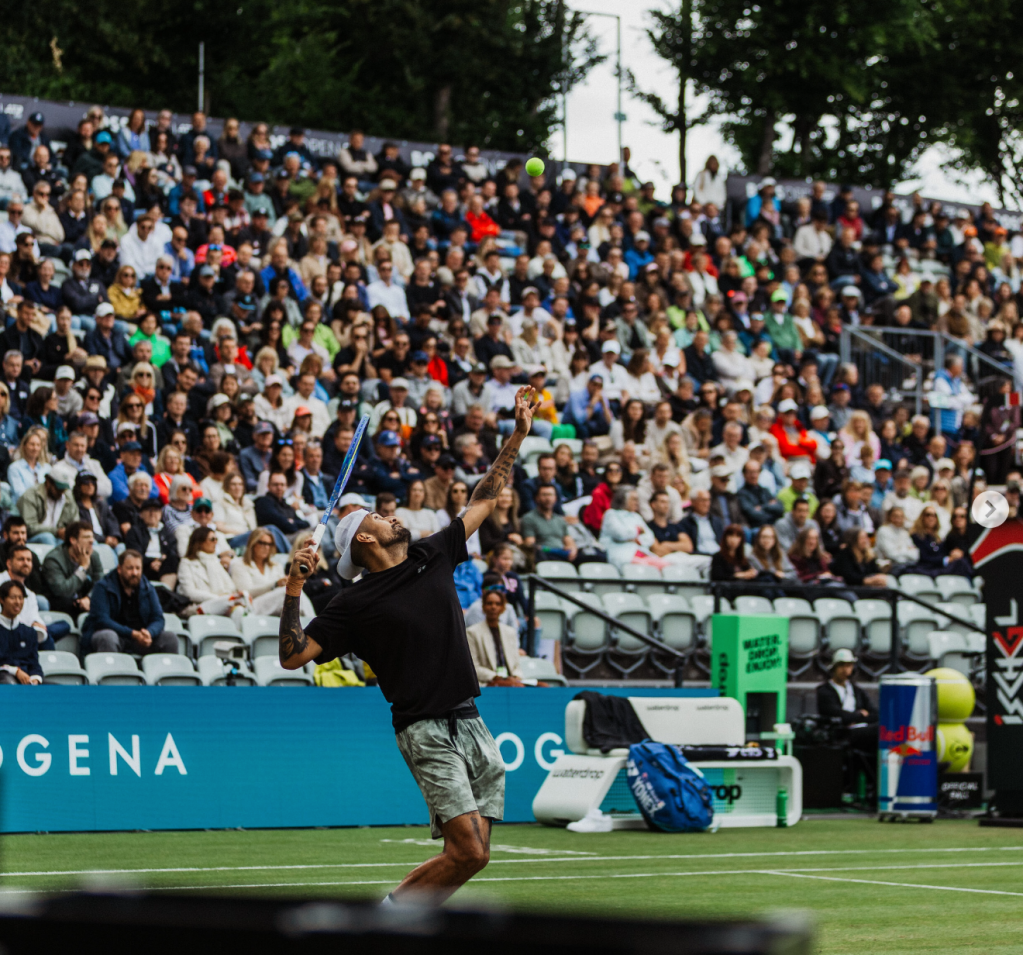
In June, Australian former world number 13, Nick Kyrgios made his long-awaited comeback to the ATP tour on the grass of Stuttgart. He played his last ATP tour match at the Brisbane international in January but has since struggled with wrist and knee issues that have kept him off court until now. The 31-year-old put on a strong first showing against 8th seeded Frenchman Corentin Moutet before falling to an inspired Japanese qualifier in the form of Sho Shimabukuro. Here are my 5 key takeaways from his comeback.
Takeaway 1: Movement on grass and physical condition
Firstly, moving on grass is unlike moving on the other playing surfaces (Clay & Hard) as grass is sensitive to rain, which can cause players to slip unexpectedly. However, Kyrgios has prowess on the grass courts as demonstrated by his previous form (he was runner up to Novak Djokovic at Wimbledon in 2022). So, he was relatively unfazed by the movement required on grass and he was untroubled as he moved both cross court and up to the net with relative ease with his typical and vintage swagger. This, unlike his French opponent, who is far more at home on the Parisian clay.
Both Kyrigos’s wrist and knee appeared healthy and fully recovered although he appeared to have a small amount of precautionary taping on his right wrist. These two joints are vital cogs in a grass court game as the knees are required to get down lower to the low bounces of a typical grass court and the wrist is vital in generating the spin required to get the ball up and over the net from a low trajectory. These are both skills that Nick Kyrgios specialises in with his whippy and wristy forehand that have caused so many of the greats, including both Roger Federer and Rafa Nadal problems over the years. Ultimately, both his movement and physical condition appeared as good as can be expected when an athlete returns from a long layoff due to injury.
2. Serve quality and free points
Kyrgios’s serve was in excellent rhythm against Moutet as illustrated by the fact that he did not face a single break point against the Frenchman. He landed both accurate and powerful first serves with regularity, allowing him to control the points behind his serve with his explosive style of first strike tennis. This expelled any concerns that his wrist injury may have damaged his serve, which is widely considered to be his biggest weapon. During the match he wore out all four corners of the service boxes whilst hitting speeds of 130+ mph. This enabled him to churn out free points on his own service games whilst attacking his opponents’ service games.
However, in a closely fought second set against Shimabukuro his first serve percentage did drop off slightly in the tiebreaker thus allowing the man from Japan to seize control. Perhaps a higher first serve percentage in the tiebreaker would have seen him sneak over the line in straight sets. However, on the whole an encouraging serving performance after much uncertainty around how his serve would hold up.
3. Rally tolerance
Nick Kyrgios is not a man known for grinding out long rallies and breaking down opponents physically. He is famed for his flamboyant and at times scarcely believable shot making ability. Under the gloomy German skies of Stuttgart, he seemed to have lost none of this ability as he frequently attempted his signature and feathered dropshots as well as mixing in underarm serves on set points and no look shots at the net. His exciting brand of tennis drew appreciative gasps from the crowd and sometimes even his opponent, although whether this was appreciative or bewilderment is up for debate. However, when required he was also able to construct longer points but couldn’t resist finishing them with a dropshot followed by whipping, dipping and banana like passing shots.
Both he and Moutet possess this flamboyant style of tennis with both frequently complementing each other figuratively and complimenting each other literally during the match as Kyrgios congratulated Moutet on one of his winners with a “That’s ridiculous!” and Moutet responded with thumbs up gestures when the roles were reversed. However, the Australian’s rally tolerance was given a more strenuous work out against his more solid and consistent Japanese opponent who was unrelenting and came up with some delightful touches of his own when he ventured to the net. Given that Kyrgios was able to stick out a few rallies when needed whilst still mixing in his unique brand of tennis, I think he will be satisfied with this facet of his game on his return.
4. Match sharpness and decision making
Kyrgios is not a player known for being a mental rock with outbursts on court possible at any moment as he often wears his heart on his sleeve which whilst sometimes a refreshing change for spectators, it can, at times, also be his downfall.
His first match against Moutet was fairly comfortable and didn’t require too many big decisions to be made in pressure moments apart from the pivotal moment when ironically the most pressure is on, serving for the Match. During this critical moment, two loose points from Kyrgios, to go 0-30 down perhaps revealed a few cracks in the match sharpness and decision-making. However, these were followed by several big and crucial first serves to get him out of trouble and ultimately over the finish line which should be encouraging after a lack of Pro matches for six months.
Against Shimabukuro however, success in the big moments such as the second set tiebreaker and a late break of the Kyrgios serve in the third set evaded him as the Japanese qualifier, debuting inside the top 100 this week, was able to come out on top. However, much credit should be given to Shimabukuro as he played tennis at a level far superior to his ranking and was only stopped in the tournament by the American top seed and eventual champion Ben Shelton. This is the area that I am sure he will most be looking to batten down the hatches on in his next tournaments.
5. What else might we see
Grass is a surface much loved by Kyrgios and is arguably the surface on which he is most dangerous – he has consistently beaten top ten opponents on the grass and even after years away from it, he looked right at home on the green turf. Whilst he was awarded a wildcard to feature for the Halle Open. He has to withdraw on the eve of the tournament citing a knee injury.
Kyrgios unfortunately didn’t receive a wildcard for Wimbledon and was ineligible to compete at the Championships qualifying event. This was unlucky for him given that Wimbledon is a tournament where he has tasted so much success including a win over the then ranked world number one Rafa Nadal in 2014.
If he can stay fit and healthy we may see him on the fast hard courts of Montreal and Cincinnati that will also suit his brand of tennis before finishing the North American hard-court swing at the final grand slam of the year, the US Open in New York.
If you get the chance, tune in to get a glimpse of this fun and gripping entertainer disguised as a tennis player.
 Beyond the Score
Leave a comment